The digital marketing market often operates with abstract terms. What users colloquially call an "SMM Panel", engineers define as an API Request Routing Gateway.
For a student, a junior marketer, or a business owner, understanding this distinction is crucial. It separates those who blindly press buttons from those who understand the underlying mechanics of automation.
This guide analyzes the infrastructure: from the moment a request is created to its actual execution on the server layer.
1. What is an SMM Panel: Dual Definition
To truly understand the tool, we must separate the marketing interface from the technical reality.
The Surface Level (For the User)
An SMM Panel is a web-based marketplace where digital metrics (subscribers, views, interaction signals) are purchased in bulk. It functions like any e-commerce dashboard: you select a category, input a target link, and process a transaction.
The Core Level (For the Engineer)
Technically, an SMM Panel is a Control Plane connected via API (Application Programming Interface) to a network of execution servers. The panel does not "generate" the metrics itself. It acts as a dispatcher: it accepts your command, validates the budget, and routes the task to a server with available capacity.
In simple terms: Think of it as a logistics center. You submit a shipping order, and the system decides which truck (server) will transport your cargo (request) and which route it will take.
2. How It Works: Under the Hood
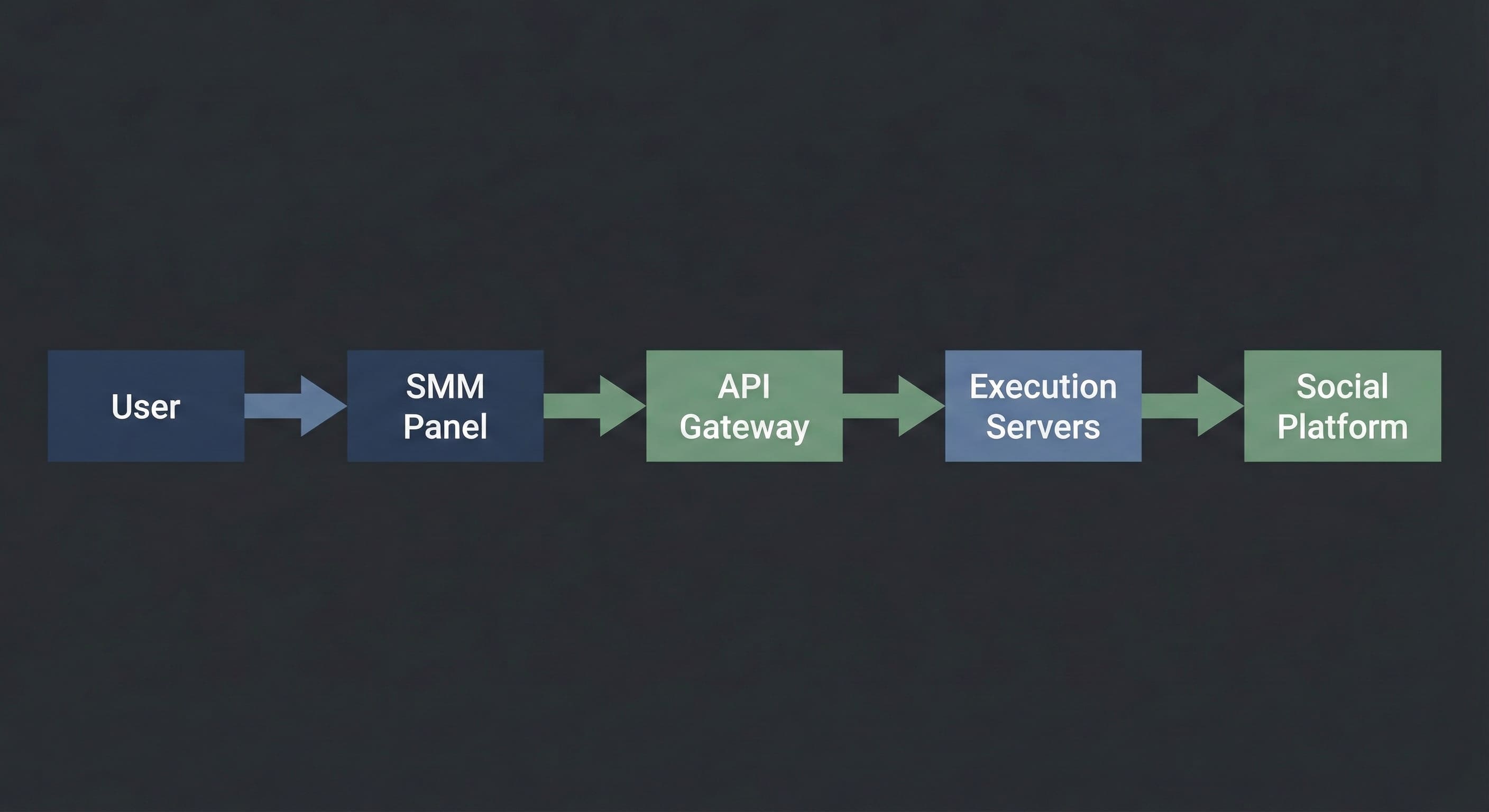
The execution process is a linear data transmission chain. It remains consistent regardless of the specific interface you use.
[How it looks to you]:
You select a service (e.g., "Telegram Views").
You paste the link to the post.
You specify the quantity (e.g., 1,000).
You click "Submit".
[What happens inside the system]:
Validation: The script checks if the link format is correct and if the user balance covers the transaction cost.
Routing: Your order is assigned a unique ID and transmitted to the API Gateway.
Queue: If the upstream server is available, processing begins immediately. If the server is under high load, the order enters a "Pending" state, waiting for a slot in the execution queue.
Execution: The server initiates the interaction signals according to the script.
Completion: The system receives a "Finished" signal and updates the status to "Completed".
Critical Note: This is not magic. It is a script. It executes exactly what you input. If you provide a broken link or a closed profile, the system may still attempt execution because it does not analyze context—it only processes code.
3. The Dictionary: Industry Terminology
To operate effectively, you must understand the technical vocabulary. Misunderstanding these parameters often leads to budget waste.
Start Time: The latency period before execution begins.
Instant: Processing starts within 0–5 minutes.
1h / 12h: The task is scheduled for a later window.
Speed (Throughput): The maximum number of actions the system can deliver per 24 hours.
Example: "Speed 5k/day" means the system will throttle delivery to 5,000 units daily to stay within safety thresholds.
Drop Rate: The percentage of metrics that may be removed by the social platform’s cleanup algorithms over time.
Refill / Non-Drop: A guarantee feature where the system automatically re-queues lost metrics to restore the original count.
Drip-Feed: A scheduling logic that splits one large order into multiple smaller batches.
Example: Instead of 1,000 likes at once, you configure "100 likes every 60 minutes". This smoothes the traffic curve to mimic organic behavior.
4. Market Hierarchy: The Supply Chain
The SMM market is structured like a wholesale supply chain. Knowing your position helps you avoid overpaying.
Providers (The Source): These entities own the physical hardware or the software logic that generates the signals. They operate via API only and rarely deal with retail customers.
Resellers (The Panels): These are platforms connected to Providers. They build the user interface, handle customer support, and curate the service list.
Note: Approximately 90% of panels on the market are resellers. This is standard. A high-quality reseller adds value by filtering out unstable servers and providing a single access point to multiple sources.
End Users (You): Agencies, freelancers, students, and businesses.
5. Why This Exists: Practical Use Cases
Beginners often mistake these tools for "vanity metrics." Professionals use them for specific infrastructure tasks.
A. Social Proof Engineering
User psychology is linear: people are more likely to follow a channel with 1,000 members than a channel with 5.
Goal: Establish a baseline visual authority to lower the barrier for organic subscriptions.
Tool: Initial population of counters (subscribers, views).
B. Reputation Management (ORM)
When a brand faces a targeted negative attack, positive or neutral signals can prevent reputational damage.
Goal: Balance visibility.
Tool: Routing positive signals to neutral comments to displace negativity from the top of the feed.
C. Hypothesis Testing (A/B Testing)
Media buyers often need to test ad creatives. To see if an ad performs, it sometimes needs "pre-heating."
Goal: Quickly validate if a creative can gain traction.
Tool: Automated interaction signals on ad posts.
6. Safety & Limits: How to Avoid Bans
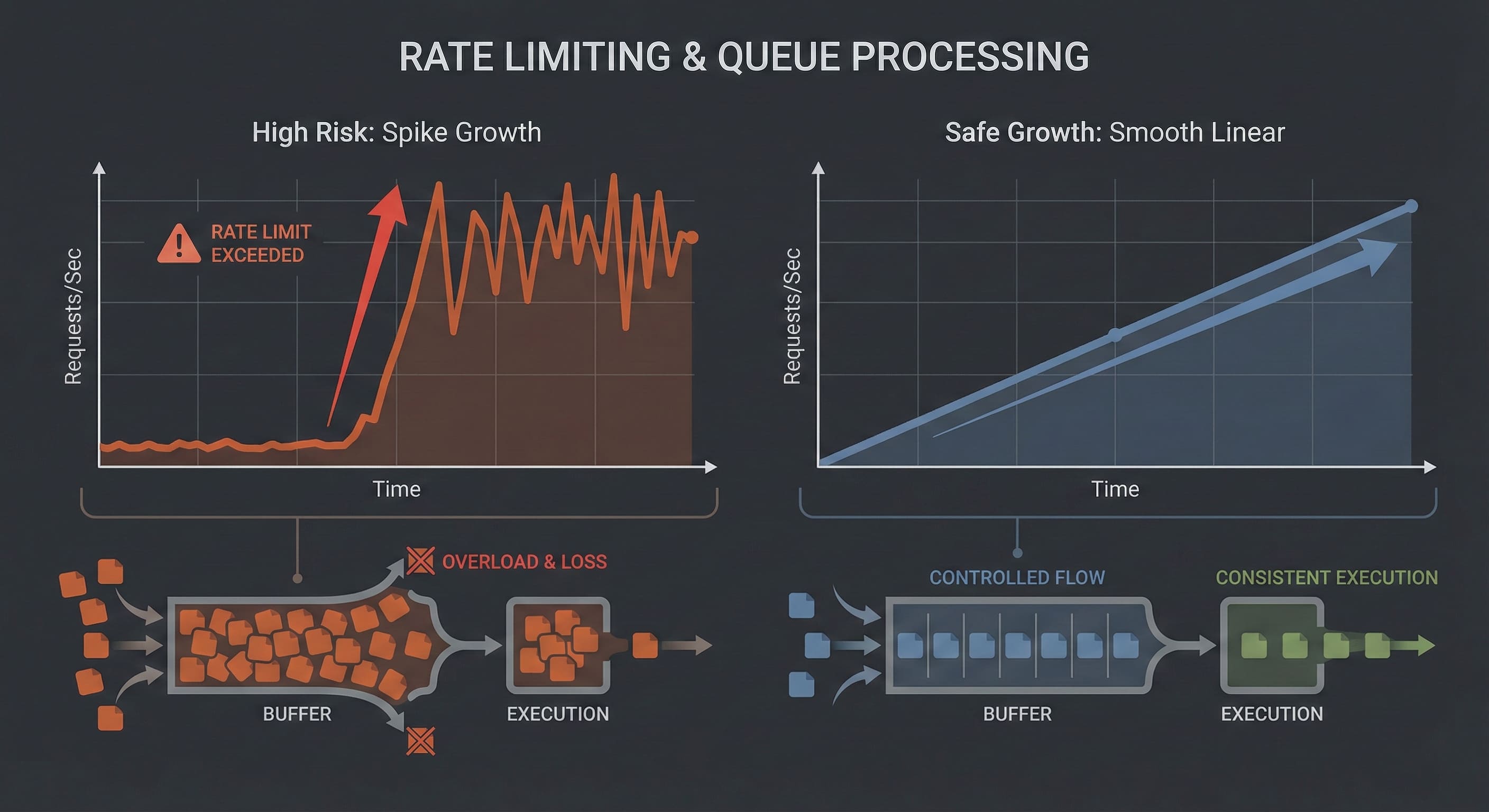
The biggest fear for new users is account suspension. It is important to understand: Platforms do not ban you for using a panel. They ban you for anomalous behavior.
Algorithms look for mathematical deviations, not the source of the traffic.
The Red Zone (Errors):
❌ Velocity Spikes: An account created yesterday suddenly gains 50,000 followers in one hour. This triggers automated flags. ❌ Empty Profiles: Traffic is directed to a profile with no avatar and no content. ❌ Metric Imbalance: A post has 10,000 likes but 0 views and 0 impressions. This is mathematically impossible in an organic environment.
The Green Zone (Best Practices):
✅ Smooth Curves: Use "Drip-Feed" or low-speed services. Growth should look linear, not vertical. ✅ Complexity: Mix different signal types. Likes should be 5–10% of Views. ✅ Gradual Scaling: Start small to test the platform’s reaction before scaling up.
The Golden Rule: Operations should remain within the plausible limits of human behavior. Slower is safer.
7. Troubleshooting: When Things Wait
Since this is technical infrastructure, latency and errors occur. This is operational reality.
Status "Pending" for a long time:
Cause: The server queue is full, or the upstream provider is undergoing maintenance.
Action: Wait. The system will either execute the order when capacity opens or cancel it and refund the balance.
Status "Partial":
Cause: The server delivered a portion of the request (e.g., 500 of 1,000) but could not complete the rest due to updated platform limits.
Action: You are charged only for the delivered amount. The remaining funds return to your balance. You can try a different server.
Status "Canceled":
Cause: Broken link, private profile, or geo-restrictions.
Action: Check your profile settings (it must be Public) and link format.
A Tool, Not Magic
An SMM Panel is a powerful automation utility. It removes manual labor, standardizes execution, and provides control over volume.
However, it has strict boundaries:
It provides Infrastructure, not Marketing Strategy.
It delivers Numbers, not Loyalty.
It is an Assistant, not a replacement for high-quality content.
Treat the panel like an engineer: read the technical descriptions, respect the rate limits, and always test on small volumes before deploying large-scale campaigns.